Possession is nine-tenths of the law. In the dog world, however, it’s ten-tenths of the law.
Even for dogs that aren’t especially possessive, asking your dog to give up the item that they currently have can be a challenge! There are two main parts to Drop It – teaching your dog to open their mouth and release the object they hold, and teaching your dog that it’s always worth it to do so.
Drop It is an essential safety skill! We can use it to keep our dogs safe when they get ahold of dangerous items, and prevent intestinal blockages from ingestion.
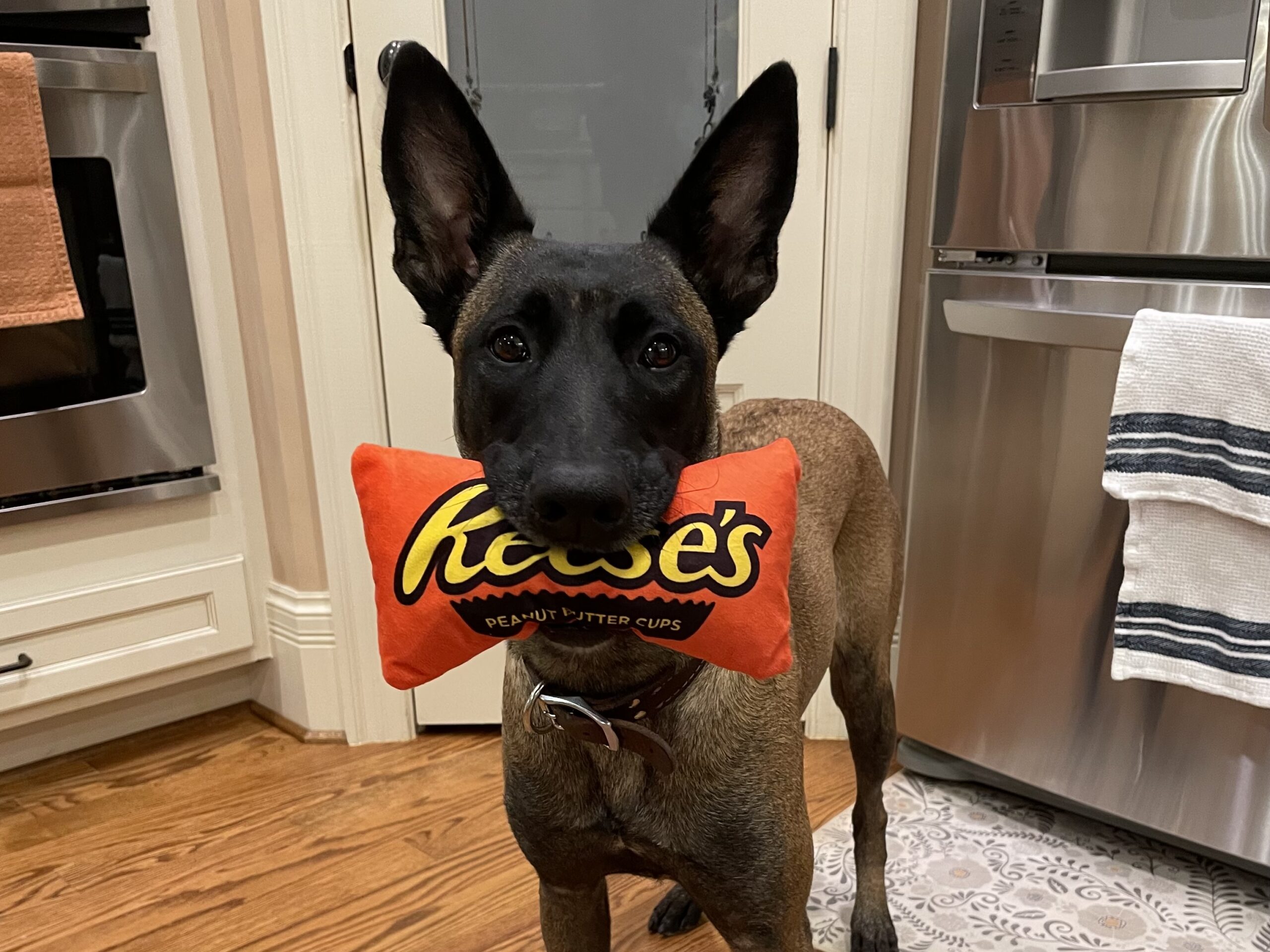
When your dog knows Drop It, they will open their mouth and drop any object to the ground on cue.
Drop It: Basics
What you’ll need: your dog, an object*, treats
* The best object is one that your dog enjoys having in their mouth, but doesn’t value high enough that they wouldn’t happily trade for food. It should also be safe for your dog to keep in case they decide they don’t want to play! This is usually best done with a toy!
- Give your dog the object! Let them enjoy it for a little bit & get satisfied with it.
- Say “Puppy, drop it!” then drop a handful of high value treats on the ground. Our goal is for them to spit their toy out and eat the treats on the ground instead.
- As an alternative, you can instead hold a stinky high-value treat in front of your puppy’s nose! If he spits his toy out, he gets the treat!
- Praise them for doing a good job, then encourage them to interact with their toy again!
- You can do this once or twice per session! Don’t go overboard, as this can accidentally teach them not to play with their toy and to instead drop it every time they pick it up.
Drop It for Dogs Who Don’t Want Food
Some dogs are super toy motivated, and not at all food motivated. Good luck trying to trade a tug for a cookie! Insisting on giving them food they don’t want is a great way to spoil treats for them. Instead, do some thinking on what they like about their toy. Do they like keeping it? Do they want you to tug, or throw it? Do they like shredding or chewing? Do they want to be chased with it?
If your dog likes to hoard, try using multiple toys. This game is called “two-toy” where we use two of the same toy and ask our dog to drop the toy they have in order to get the one we are holding.
- Throw one toy for your dog to get.
- As they come back, show them the toy you have. Wait for them to drop theirs.
- Pick up or step on their dropped toy, then throw. (This prevents them from stealing both!)
- Repeat.
If your dog is particular about a specific toy, two-toy might not work well (even if they’re exactly the same!) In this case, we might need to play the “dead toy” game. This works well for fetch or tug.
- Start with a toy long enough to tug!
- Start tugging. Make the game fun.
- After your dog is pretty satisfied, grab and immobilize the toy, and become boring. (This is the “dead toy”)
- Wait for your dog to let go of the toy. Some dogs benefit from you saying “Drop it” at this point. Be patient!
- As soon as your dog lets go, say “Yes!” in a super happy voice and immediately restart the game they want to play (fetch, chase, tug, etc)
- Repeat!
Drop It for Resource Guarding / Possessive Dogs
Dogs who are especially possessive or are showing any signs of resource guarding can also learn Drop It, but special care must be taken into consideration! If you have a dog with resource sensitivity, please check with your trainer before following these steps. All dogs’ behavior and training plans are different, so always follow advice in your specific training plan even if it conflicts with advice in this article.
Here are some basic guidelines for working with resource sensitive dogs:
- When they drop their object in order to eat the food, don’t pick it up immediately (or at all). For possession sensitive dogs, there’s a big difference between not possessing a prize and seeing someone else possess their prize.
- If the object is dangerous or otherwise needs to be separated from your dog, lead them away from it with a trail of snacks “Hansel and Gretel” style. Once they’re safely contained, return and pick it up without them seeing – or have a second person pick it when they’re out of sight.
- Dropping an object into your hand and dropping an object onto the ground can be vastly different in terms of difficulty for possessive dogs.
- Pay attention to your dog’s value system, and reward accordingly. The value of any given item may change for your dog from day to day or hour to hour. Two “identical” items may – seemingly arbitrarily – be valued differently.
- Avoid creating or practicing conflict or conflicting feelings. (You can think of conflict like an inner battle – when your dog is torn between keeping their object and dropping it!) If you notice your dog hesitates to drop something, take note of it – and stack the deck in your favor next time!
- For a cue to stay reliable, your dog should always feel like they’re winning when they perform it. If your dog has conflict, they don’t feel like they’re winning.
- For dogs who are especially hesitant to relinquish items, or those who have had a lot of internal conflict around resources, you may have to start way easier with them. For some pups, our first step is just tossing a free cookie then walking away so they can eat without worrying about us loitering, then adding challenge from there.